
For many people, the idea of losing power or water is unfamiliar—something they’ve rarely, if ever, experienced, especially here in the Gulf. These systems are so reliable that they fade into the background of daily life. Electricity flows, water runs, and everything simply works without a second thought.
But imagine, for a moment, if that changed. If the power went out. If the water stopped running. Not for hours, but for weeks—and not as an accident, but as something intentional. It may not have unfolded this way in the current war, but the possibility is no longer theoretical.
That is what modern wars have become: the strategic threat of disrupting daily life and the economies of entire nations at scale. And these disruptions are not always immediate or localized; they extend across global energy networks and supply chains.
And here is the part that we are learning with this war. The systems that are targeted first are not military systems. They are the everyday ones. The electricity. The shipping lane that carries the food. The desalination facility that produces the drinking water. The things nobody notices until they are gone.
For years sustainability has been framed as a long-term agenda. A future commitment. A moral obligation. Important, yes, but not urgent.
Conflict has a way of ending that conversation fast.
Because when those systems fail, sustainability stops being a strategy. It becomes the difference between a city that keeps running and one that does not. Between a community that holds together and one that falls apart.
That is what the current conflict in the Middle East is showing us. Not through politics. Through pressure. Real pressure on real systems that real people depend on every single day.
And that changes everything about how we should be thinking about this.
Sustainability and security are the same conversation
Energy, water and food are not sustainability issues in the abstract. They are the systems that keep societies running. And when they fail, they do not fail politely or gradually. They fail fast, and they fail together.
What we tend to overlook is that the things we build for sustainability are the same things that keep a country standing when systems come under pressure.
A solar panel on a rooftop is not just an environmental decision. It is an energy security decision. It means that when a power station goes offline, that building still has power. A local food program is not just about reducing carbon from shipping. It is about having something to eat when the ships stop coming. Water efficiency is not just about conservation targets. It is about making sure a city can survive on less when the supply gets cut.
None of this is new thinking. But war has a way of making it obvious. Sustainability and security are not two separate conversations happening in different rooms. They are the same conversation. And we need to remember that.
The Gulf Cooperation Council imports around 85 percent of its food. Most of it travels by sea, through a single narrow channel. Over 70 percent of GCC foodstuffs pass through the Strait of Hormuz. The UAE holds strategic reserves covering roughly four to six months of staples. Kuwait, Qatar and Bahrain, effectively landlocked if the Strait closes, depend on overland routes through Saudi Arabia. These numbers, cited calmly in reports and strategy documents for years, read very differently when shipping lanes actually close.
And then there is water. Most drinking water in Saudi Arabia, the UAE, Kuwait and Qatar comes from desalination, between 70 and 90 percent depending on the country. Desalination runs on energy. Energy runs on centralized infrastructure. Centralized infrastructure is, by its nature in this modern war, a target. Strike one facility and you do not just knock out electricity. You knock out water. And without water, many systems including food systems stop functioning within days.
War does not introduce this problem. It just makes it impossible to ignore.
The fragility was always there. War just made it visible.
In peacetime, we can afford to pretend that long, centralized supply chains are stable. We treat resilience as a cost center and efficiency as the goal. We optimize, consolidate and centralize. We build bigger plants, longer pipelines and tighter supply chains because that is what efficiency looks like.
And then a drone hits something, and the whole thing stops.
Ukraine has been living this reality since February 2022. Russian attacks have destroyed or damaged roughly two-thirds of Ukraine’s pre-war power generation capacity. Entire regions lost electricity. Heating systems failed in winter. Water pumping stations went offline. But here is what is interesting. Ukraine’s response was not to rebuild the same centralized system faster. It was to build something fundamentally different.
By early 2024, Ukraine had added nearly 1,500 megawatts of distributed solar capacity, enough to power around 400,000 households. By 2025, another 1.5 gigawatts had been installed. Battery projects that take two years in Europe were being completed in six months. Small. Spread out. Local. The kind of system where no single strike could take it all down, because there was no single point to strike.
Design Drives 80% of the Impact
The Ellen MacArthur Foundation points out that decisions made at the design stage influence around 80% of a product’s environmental impact. Most of the damage locks in long before the product reaches a single consumer.
The circular economy asks better questions before anything gets made. Could this product last longer? Is it easy to repair? Can the manufacturer take it back and reuse the materials without losing their value? Those questions do not happen at the bin. They happen in the design studio, years before any product reaches a shelf.
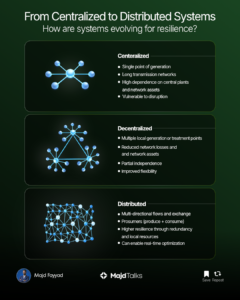
And honestly, that is the lesson. Distributed systems are the solution. Not because they are perfect, but because they are the only kind that holds when everything around them is falling apart.
Aggressive efficiency is a resilience strategy, not just a net zero strategy
There is one piece of this that almost never gets the attention it deserves. And that is simply using less.
Not as a sacrifice. Not as a target in a report. But as a genuine strategy for staying functional when supply chains break down.
Europe showed what this looks like in practice. When Russian gas stopped flowing after the invasion of Ukraine, the EU did not just scramble for new suppliers. It cut demand. Between August 2022 and March 2024, EU countries reduced natural gas consumption by roughly 18 percent compared to the previous five year average. That is not a small number. That is what demand reduction looks like when survival is the goal.
The logic is simple when you think about it. The unit of energy you never needed to produce is the one that cannot be disrupted. The liter of water you conserved is the one that does not have to be desalinated under pressure. The food that does not get wasted is the food that does not need to be imported, stored or defended.
Demand reduction does not get the headlines that solar farms do. But in a disruption scenario it is often the first thing that actually works. It buys time. It lowers exposure. And it makes every other resilience investment go further. In that sense, using less is not a sign of weakness or sacrifice. It is one of the most powerful resilience tools we have.
Systems thinking is the missing piece
War does not respect boundaries between sectors. And neither do the failures it causes.
Systems thinking is not a workshop exercise or a consulting framework. It is the genuine recognition that pulling one thread changes everything else. Sustainability built on silo thinking, where energy strategy sits in one team, water policy in a separate department and food security somewhere else entirely, is sustainability that will fail when it is tested.
Real progress can be achieved when we treat energy, water and food as a single integrated challenge. We should not ask whether each system is efficient on its own, but whether it can bend without breaking or damaging other systems. Those are very different design goals. And they lead to very different outcomes.
What this means right now
The conflict in the Middle East is a real-time stress test of systems that sustain modern life—and it is making one thing unmistakably clear: sustainability is not what you build for the future; it is what protects you in the present.
Sustainability is not only about saving the planet in the future. It is about keeping systems running when everything starts failing. And right now, that is not a theoretical concern. It is a live one.
If there is a lesson to be drawn from all of this, it is not that sustainability needs to be accelerated. It is that it needs to be redefined.
Not as a long-term aspiration. Not as a parallel agenda. But as the foundation of resilience in an unpredictable world.
The systems we build today will be tested. Not only by conflict, but by climate shocks, resource constraints and geopolitical instability. The question is not whether disruption will occur. It is whether our systems are designed to withstand it.
Sustainability, in this light, is not only about preserving the future. It is about maintaining the present.
References
- AGSI, Water and Food Security in a Militarized Gulf, https://agsi.org/analysis/water-and-food-security-in-a-militarized-gulf/
- AP News, The Gulf Resource Most Imperiled by War May Be Water Not Oil, https://apnews.com/article/iran-war-desalination-water-oil-middle-east-12b23f2fa26ed5c4a10f80c4077e61ce
- ReliefWeb / FAO, Building Resilience in Conflict-Affected Agrifood Systems, https://reliefweb.int/report/world/building-resilience-fragile-and-conflict-affected-agrifood-systems-through-water-energy-food-nexus-approach
- Brookings Institution, Ukraine’s Energy Sector Is a Key Battleground, https://www.brookings.edu/articles/ukraines-energy-sector-is-a-key-battleground-in-the-war-with-russia/
- Yale E360, How Ukraine Is Turning to Renewables to Keep Heat and Lights On, https://e360.yale.edu/features/ukraine-war-renewable-energy
- European Council, How Did the EU Respond to the 2022 Energy Crisis, https://www.consilium.europa.eu/en/policies/how-did-the-eu-respond-to-the-2022-energy-crisis/
- MDPI Water Journal, Conflict Resilience of Water and Energy Supply Infrastructure: Insights from Yemen, https://www.mdpi.com/2073-4441/12/11/3269
- SolarQuarter, Shams Dubai Rooftop Solar Initiative Connects Over 725 MW Across 8,430 Buildings, https://solarquarter.com/2025/06/25/shams-dubai-rooftop-solar-initiative-connects-over-725-mw-to-grid-across-8430-buildings/
- Stockholm Environment Institute, Three Key Trends in the Geopolitics of Sustainability, https://www.sei.org/perspectives/three-key-trends-in-geopolitics-of-sustainability/
- UNDP, Championing Water Resilience in Yemen Through Desalination Efforts, https://www.undp.org/arab-states/stories/championing-water-resilience-yemen-through-desalination-efforts
- ICRC, Syria: Up to 40% Less Drinking Water After 10 Years of War, https://www.icrc.org/en/document/syria-water-crisis-after-10-years-war