
We all grew up thinking the recycling bin was the answer. Sort your plastics. Rinse your cans. Put the right things in the right bin. It felt like enough. Like we were doing our part.
Recycling became the environmental habit people could actually hold onto. It was simple, manageable, and easy to believe in.
But here is the part nobody really told us. Recycling was never designed to solve the waste problem. It deals with what is left after the real damage has already been done. For years, we treated a symptom and called it a solution. Only now are we starting to see the cost of that mistake, in time, in money, and in missed opportunities.
The shift happening now is bigger than recycling. And once you see it, it is hard to unsee.
The Number That Changes Everything
In May 2025, Circle Economy and Deloitte Global released the Circularity Gap Report 2025, and one number has the power to change how you see this entire conversation: only 6.9% of the 106 billion tonnes of materials used by the global economy each year come from recycled sources. That figure has fallen by 2.2 percentage points since 2015, even as recycling rates have grown.
So we are recycling more, and the world is recovering less of its materials than before. How does that happen?
The answer is simple: material consumption is growing faster than our ability to recycle it. The report also found that even if we recycled every recyclable material on the planet without changing anything else, global circularity would only rise to about 25%. The remaining 75% cannot be recycled at all. It needs something fundamentally different.
That something is the circular economy, a system built around keeping materials in use for as long as possible rather than disposing of them after a single use. It is not just an upgraded version of recycling. It is a broader system that includes it, but goes much further.
Why We Confuse the Two
It is easy to see how the confusion started. Both sit under the sustainability umbrella. Both promise to keep waste out of landfill. And recycling has been part of public consciousness for decades. The environmental movement of the 1970s gave birth to the recycling symbol, Earth Day, and the first curbside collection programs, and from that point on it became the default answer whenever anyone asked what we should do about waste and diminishing natural resources.
Circularity tends to get reduced to recycling, but recycling is only the most visible part of a much larger system. It sits at the tip of the iceberg. The circular economy represents the entire iceberg, not just the deepest layer. It includes strategies like reuse, repair, refurbishment, remanufacturing, and repurposing, along with system-level approaches such as circular sourcing, reverse logistics, and sharing models.
Its core aim is to eliminate waste and extend the lifetime of resources and products. It can begin at the design stage, but it also continues after a product is made through reuse, repair, and recovery.
(Adapted from ISO 59004)
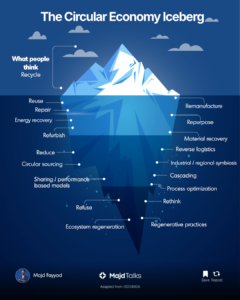
Recycling steps in after a product gets made, used, and discarded. The circular economy spans the entire lifecycle, from design to reuse, repair, and recovery.
Design Drives 80% of the Impact
The Ellen MacArthur Foundation points out that decisions made at the design stage influence around 80% of a product’s environmental impact. Most of the damage locks in long before the product reaches a single consumer.
The circular economy asks better questions before anything gets made. Could this product last longer? Is it easy to repair? Can the manufacturer take it back and reuse the materials without losing their value? Those questions do not happen at the bin. They happen in the design studio, years before any product reaches a shelf.
A System, Not Just a Step
The transition to a circular economy rests on three core principles. Stop waste and pollution from being created in the first place. Keep products and materials circulating at their highest possible quality. Give natural systems room to recover and reduce biodiversity loss.
Recycling touches the second of those when it works well. It barely addresses the first, and does almost nothing for the third.
Here is a simple way to see the difference. Take a plastic bottle. When you recycle it, the material gets a second life. But not all plastics can be recycled in the first place. And even when they can, recycling is not infinite. Each time plastic goes through processing, it loses quality. Eventually, it cannot be recycled at all. The loop has a limit.
The Circularity Gap Report 2025 makes the point bluntly: recycling captures the lowest economic value of all circular strategies. The real value in any product is not its raw material. It is the design, the engineering, the labour, and the logistics that went into making it. Repair preserves that value. Remanufacturing takes a used product, restores it to its original condition, and puts it back into use at full quality. Recycling skips all of that and melts everything down to raw material, recovering only a small fraction of what the product was actually worth. As the Ellen MacArthur Foundation puts it, circular processes should aim to keep the maximum amount of embedded value intact, resorting to recycling only when all other options are exhausted.
That is what separates the circular economy from every waste strategy that came before it. It does not ask how we manage the end of a product’s life more efficiently. It asks why that endpoint was ever designed in the first place.
The Business Case Is No Longer Optional
For leaders still treating circularity as a marketing exercise, the 2025 data tells a different story.
A World Economic Forum and Bain and Company survey of 420 global manufacturing leaders found that 97% of businesses implementing circular solutions do so for profitability and competitive advantage, not just sustainability. More than 70% expect circular business models to increase their revenue by 2027.
The picture gets sharper when you look at what came next. A November 2025 report by Bain and Company, the World Economic Forum, and the University of Cambridge found that while 79% of manufacturing executives say circularity is crucial to their business today, only 20% feel their circular supply chains are fit for purpose. The gap between belief and action is exactly where the opportunity lives right now.
And the opportunity is significant. The transition towards a circular economy is estimated to represent a $4.5 trillion global growth opportunity by 2030, driven by savings on material costs, new product-as-a-service markets and the creation of jobs in repair, remanufacturing and recycling industries.
The circular economy is not asking companies to sacrifice growth for the planet. It offers a different path to growth entirely.
What Governments Still Need to Do
Most sustainability policies have been recycling policies with a bigger font. Governments set sorting targets, build collection systems, and roll out public awareness campaigns. All of that matters. None of it on its own is enough to accelerate the transition we actually need.
The Circularity Gap Report 2025 makes a bolder ask. Shift tax burdens from labour to resource extraction. Redirect subsidies away from linear industries. Set circular economy targets with the same seriousness attached to net zero goals.
The European Union Circular Economy Action Plan moves in this direction, holding producers accountable for their products after consumers are done with them. When a company knows it will have to take its product back, it stops designing that product to fall apart.
How Business Leaders Can Start Their Circularity Journey
Knowing the data is one thing. Knowing where to start is another.
The good news is that the tools are finally catching up with the ambition. At COP30 in November 2025, the World Business Council for Sustainable Development and the One Planet Network launched the Global Circularity Protocol for Business, the world’s first voluntary science-based framework giving companies a standardised way to measure, manage, and communicate their circularity performance. Developed with over 150 experts and 80 organisations, it is widely seen as the missing link between ambition and action.
But having a framework means nothing if companies are not committing to real targets. A recent analysis of Europe’s top industrial companies found that 45% of all circularity targets focus on energy and water. Almost none touch product design, reuse, repair, or remanufacturing. Nearly half of the companies have zero quantitative circularity targets at all.
The transition is not waiting for everyone to be ready. The question for every business leader is simply this: are you shaping it, or reacting to it?
The Real Shift
Recycling has its place. But it was never meant to carry the full weight of a sustainable economy. It is one tool in a much larger system, and for decades, we treated it as the whole solution.
The circular economy does not abandon recycling. It puts it where it belongs — as a last resort, after every other option to reuse, repair, and remanufacture has been exhausted. The goal is not to manage materials better at the end of their life. It is to design a system where nothing loses its value in the first place.
In a true circular economy, waste is not a by-product to be dealt with. It is a design flaw to be eliminated. Every product that ends up in a bin represents a decision made earlier in the process that did not have to go that way.
The businesses that understand this are already moving. They are not waiting for regulation to force their hand or for competitors to show them how. They are redesigning products, rethinking ownership models, and building supply chains that hold value rather than discard it.
The window to lead this transition is open. The question is not whether your business will engage with the circular economy. It is whether you will shape what that looks like in your industry, or spend the next decade catching up to those who did.
The next move is yours: start redesigning, or start falling behind.